
What You're Actually Getting Into
Angola is a country the size of Texas and California combined, with a South Atlantic coastline running from tropical mangroves in the north to genuine desert in the south, and it has been open to independent tourism in any real sense for barely a decade. A 27-year civil war that followed independence from Portugal in 1975 kept the country largely off the travel map until the fighting ended in 2002, and oil money since then has rebuilt Luanda into a genuinely modern, genuinely expensive capital while much of the rest of the country stayed rural and undeveloped for tourism. What that leaves for visitors now is a landscape of waterfalls, desert and wildlife that neighboring Namibia has spent decades marketing, minus the infrastructure and minus the crowds.
None of that comes free. The visa is arranged in advance, not on arrival. A yellow fever certificate is checked at the border. Luanda carries a specific US government advisory about crime, and getting to places like Kalandula Falls or the Namibe desert means long drives on roads that range from decent to genuinely rough. This is a country for travelers who want to plan properly and hire local guides, not one that rewards showing up and improvising.
The honest complications
Angola is expensive by African standards: heavy reliance on imports, especially in Luanda, pushes hotel and restaurant prices toward what you'd pay in a mid-tier European city. Luanda's greater metropolitan area carries a specific US State Department advisory to reconsider travel because of armed robbery, assault and carjacking risk, a notch more serious than the general Level 2 caution that covers the rest of the country. Roads outside the capital vary enormously, some newly paved and fast, others requiring a 4x4 and a full day to cover a few hundred kilometers. And in some rural areas, decades after the civil war ended, landmines remain a documented risk away from marked and regularly traveled routes. None of this makes Angola a country to avoid, but it is a country to prepare for.
A History Worth Knowing
Angola's story runs from Kongo, Ndongo and Lunda kingdoms, through nearly five centuries of Portuguese colonization built substantially on the slave trade, into a war of independence that ended in 1975 and immediately collapsed into a civil war that lasted almost as long as the colonial era's final phase. Understanding that timeline explains a lot about the country you're visiting: why Luanda feels so newly built, why the countryside is still recovering, and why the state remains cautious about how quickly it opens up.
- Pre-1500s
Kongo, Ndongo and Lunda. Powerful Central African kingdoms controlled the region before Portuguese contact, with the Kingdom of Kongo in particular reaching considerable political sophistication.
- 15th-19th c.
Portuguese colonization and the slave trade. Portugal established coastal trading posts from the late 1400s; Angola became one of the largest sources of enslaved people shipped across the Atlantic, mostly to Brazil, over the following centuries.
- 1951-1974
Overseas province. Portugal formally reclassified Angola as an overseas province rather than a colony in 1951, a legal change that did little to alter the underlying colonial economy.
- 1961-1974
War of Independence. Nationalist movements, chiefly the MPLA, FNLA and UNITA, fought Portuguese rule until Portugal's 1974 Carnation Revolution opened the door to negotiated independence.
- 1975
Independence, then civil war. Independence was declared on 11 November 1975 by the MPLA's Agostinho Neto. The power-sharing deal between the three liberation movements collapsed almost immediately into a civil war.
- 1975-2002
The civil war. A Cold War proxy conflict, with Cuban troops and Soviet backing supporting the MPLA government against UNITA, which drew support at various points from the United States and apartheid-era South Africa. The war finally ended in 2002 after UNITA leader Jonas Savimbi was killed.
- 2002-present
Oil-fueled reconstruction. Peace brought rapid, oil-financed rebuilding, concentrated heavily in Luanda, alongside a slower, still-ongoing recovery in rural provinces still marked by the war's infrastructure damage.
Read the full history: the slave trade, the Cold War proxy war, and reconstruction
The Kingdom of Kongo, centered in what's now northern Angola, DRC and the Republic of Congo, was a sophisticated centralized state with diplomatic ties to Portugal and even the Vatican by the early 1500s. Portuguese colonization that followed was built substantially on the trans-Atlantic slave trade: Angola became one of its largest sources, with the overwhelming majority of enslaved people shipped to Brazil, another Portuguese colony, a connection that still shapes cultural and musical ties between the two countries today.
The War of Independence, fought from 1961 to 1974 by three rival nationalist movements with different regional and ethnic bases, ended only when Portugal's own 1974 Carnation Revolution toppled the dictatorship that had insisted on holding its African colonies by force. The Alvor Agreement of January 1975 was meant to create a transitional coalition government; instead, the MPLA, FNLA and UNITA turned on each other before Portuguese troops had even finished withdrawing.
The Angolan Civil War that followed, 1975 to 2002, became one of the Cold War's defining proxy conflicts in Africa. Cuban troops, at their peak numbering in the tens of thousands, and Soviet military aid backed the MPLA government; UNITA drew support at different points from the United States and from apartheid-era South Africa, which also intervened militarily. The war killed an estimated 500,000 people and displaced roughly a quarter of Angola's population before UNITA leader Jonas Savimbi was killed in combat in February 2002, prompting a ceasefire and the Luena Memorandum that finally ended the fighting.
Reconstruction. Since 2002, oil revenue, Angola is one of Africa's largest producers, has financed a rapid, visible rebuilding of Luanda into a skyline of new towers, while rural provinces further from the capital have recovered more slowly, still working through landmine clearance, road reconstruction and rebuilding basic services decades after the ceasefire.
Top Destinations
Angola splits into a rebuilt Atlantic capital, a waterfall-and-savanna interior north and east of it, and a desert coast in the far south that few outside Angola have ever seen photographed. The country is roughly twice the size of France, and road quality varies enough that the honest advice is to pick one region and commit to it: a week covers Luanda plus one major excursion well, and the Namibe desert deserves its own trip.

Luanda, the boomtown capital
Angola's capital sits on the South Atlantic, its skyline of new towers rising directly above a 1576 Portuguese fort and a waterfront promenade, the Marginal, that functions as the city's social heart. Oil money has rebuilt central Luanda fast, which makes for a strange, striking mix of colonial-era buildings, dense informal neighborhoods and glass office towers within a few blocks of each other. A full city guide, with neighborhoods, hotels, restaurants and a day-by-day plan, covers Luanda separately: see our Luanda city guide.
Kalandula Falls, wider than Victoria Falls
In Malanje Province on the Lucala River, Kalandula Falls drops 105 meters over a curtain 400 meters wide, making it wider by far than Victoria Falls even if it's less famous and considerably less visited: most days see only a handful of other travelers at the viewpoints. The drive from Luanda covers roughly 420 to 450 kilometers and takes 6 to 8 hours depending on road conditions, with a 4x4 recommended, especially in the wet season.
A trail leads down from the clifftop viewpoint toward the base of the falls, where the spray and noise are considerably more dramatic up close; hiking it with a local guide is the sensible option given the slippery basalt and limited signage. The falls are considered sacred by local communities, and guides expect visitors to treat the site with corresponding respect.
Kissama National Park
Roughly 75 kilometers south of Luanda, Kissama has been a protected area since 1938 and covers about 9,600 square kilometers of savanna dotted with large baobabs, an easy day trip or overnight from the capital. Wildlife rebuilding here has been a genuine post-war conservation project, and the park is now home to giraffes, zebras, elephants, ostriches and several antelope species reintroduced or recovered after decades of war-era poaching hollowed out the population.
Tundavala Gap
About 18 kilometers from the southern city of Lubango, Tundavala Gap is a sheer escarpment where cliffs at over 2,200 meters elevation drop nearly 1,000 meters to the plains below, part of the same geological edge that separates the Huíla Plateau from the coastal desert stretching toward Namibe. The view west from the rim, plateau giving way to a vast plain running to the Atlantic, is one of the most dramatic in southern Africa and gets remarkably few visitors for what it offers.
Namibe desert
South and west of Lubango, the Namibe desert is the northern extension of Namibia's famous Namib, a stretch of arid coastal terrain holding some of the world's oldest known specimens of Welwitschia mirabilis, a strange, long-lived desert plant found almost nowhere else on earth. The drive down the Serra da Leba escarpment road, a dramatic switchback descent, is itself one of the region's sights.
Benguela, colonial coast
One of Angola's oldest cities, Benguela retains a substantial layer of Portuguese colonial architecture, including the Cathedral of Our Lady of Fátima and the Benguela railway station, along with an ethnographic museum and streets of colorful colonial-era houses that give the city a noticeably different feel from rebuilt Luanda.
Lobito, the Restinga
A short distance north, Lobito stretches along a narrow sandy peninsula called the Restinga, with the historic Lobito train station, once the Atlantic terminus of the Benguela Railway to the copper belt of Congo and Zambia, and quiet beaches on the peninsula's ocean side.
Hidden gems beyond the main circuit
The zones above cover a first serious trip well. With extra days or a repeat visit, these reward the detour.
Miradouro da Lua
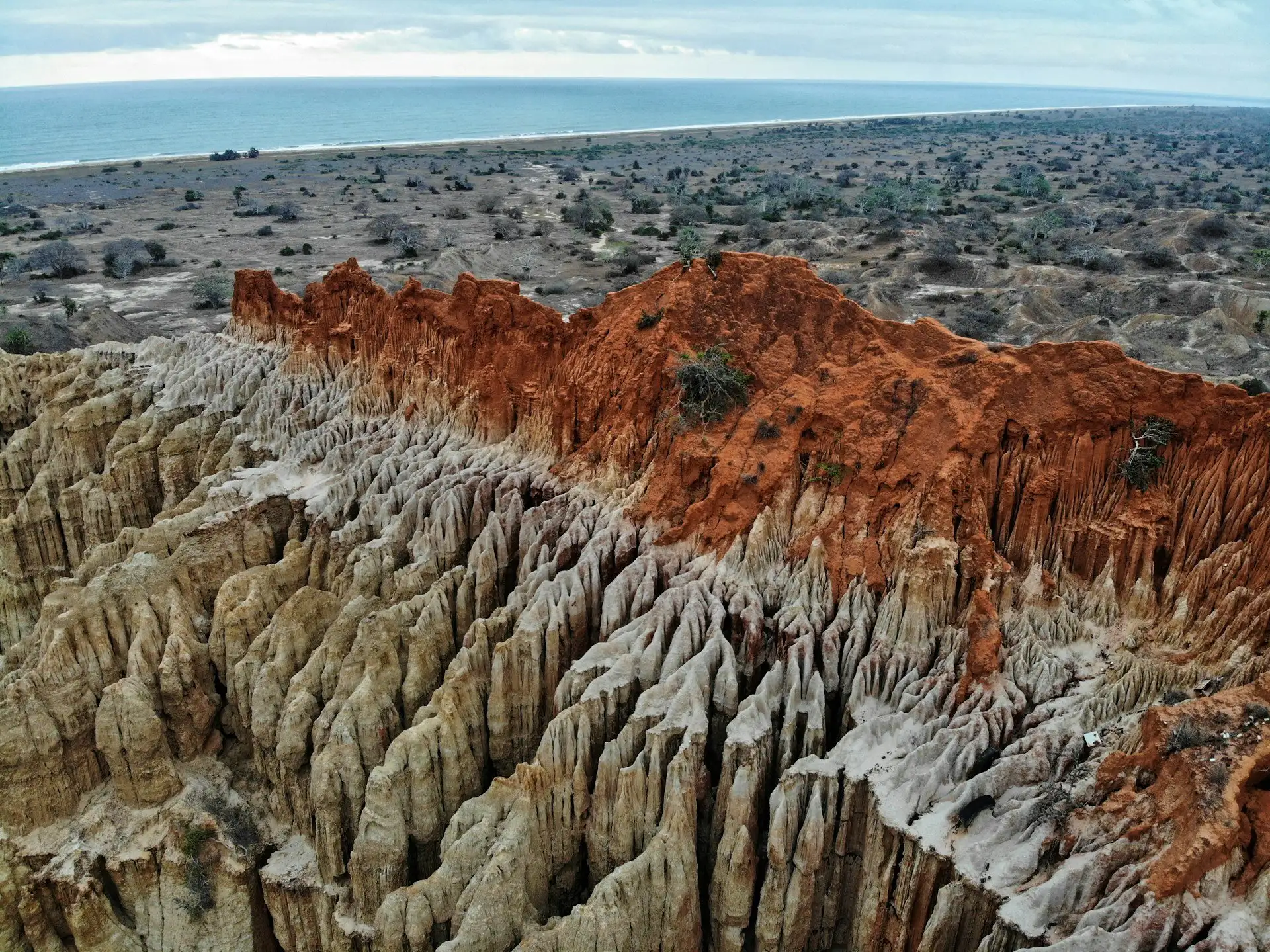
A set of ochre cliffs eroded by wind and rain into a landscape that genuinely resembles the moon, or Mars, depending on the light. An easy stop between Luanda and Kissama National Park.
Iona National Park
Angola's largest and oldest national park, a vast stretch of true desert bordering Namibia's Skeleton Coast, home to desert-adapted wildlife and dramatic dune landscapes almost nobody outside Angola visits.
M'banza-Kongo
Former capital of the Kingdom of Kongo and a UNESCO World Heritage Site, with archaeological remains of one of Central Africa's most significant precolonial states.
Culture & Etiquette
Angolan culture blends Bantu traditions, chiefly Kimbundu, Umbundu and Kikongo, with nearly five centuries of Portuguese colonial influence, most visibly in language, religion and cuisine. Music sits close to the center of everyday life: semba, widely considered the rhythmic ancestor of Brazilian samba, and kizomba, the slower, close-partner dance genre that spread from Angola across the Portuguese-speaking world in the 1980s, are both homegrown exports most visitors have heard without knowing where they came from.
Do
- Greet with a firm handshake and direct eye contact; it's the standard greeting between men and between women alike, and skipping it reads as brusque.
- Accept hospitality when it's offered. Declining repeatedly can come across as rude; a genuine, appreciative acceptance is the better instinct.
- Let elders go first and address them with visible deference; respect for age is a foundational social norm.
- Learn a little Portuguese. Bom dia and obrigado go further than English does outside international hotels.
- Expect meetings and plans to start late. Time runs more fluidly than a rigid Western schedule; build slack into any plan involving a local contact.
Don't
- Photograph government buildings, military sites or checkpoints. This is enforced, not a suggestion, and can lead to a confiscated camera or worse.
- Expect a blunt "no" in conversation. Direct refusal is often softened or avoided; read hesitation and indirect answers as a genuine no.
- Wander into musseques (informal settlements) without a trusted local guide; these dense neighborhoods carry more risk and are not set up for casual sightseeing.
- Assume US dollars work everywhere. They're accepted at hotels and upscale restaurants but not at markets or with taxis, where kwanza is essential.
- Skip the yellow fever certificate. It's checked at the border, not a formality you can talk your way around.
Deeper culture: semba and kizomba, the Kongo legacy, and Lusophone ties
Semba and kizomba. Semba developed in Angola and is widely credited as a direct ancestor of Brazilian samba, carried across the Atlantic during the slave trade era and evolving separately on each side. Kizomba emerged from semba in Luanda in the late 1970s and early 1980s, its name meaning "party" in Kimbundu, and has since become a global partner-dance phenomenon with scenes in cities from Lisbon to Paris to Tokyo, most of whose dancers have never set foot in the country where it started.
The Kongo legacy. The precolonial Kingdom of Kongo, centered on what's now M'banza-Kongo in northern Angola, reached a level of centralized political organization and diplomatic reach, including direct relations with Portugal and the Vatican by the early 1500s, that predates and complicates the simpler colonial narrative many visitors arrive with.
Lusophone ties. Angola's connection to Brazil runs deeper than a shared colonizer: the slave trade route between Angolan ports and Brazil was one of the largest in history, and cultural exchange, in music, religion and cuisine, has continued in both directions long after independence, including many Angolans who consume Brazilian television and music as a matter of daily life.
Food & Drink
Angolan food fuses indigenous Bantu staples, cassava, palm oil, peanuts and beans, with Portuguese colonial technique and abundant Atlantic seafood. Meals lean hearty and slow-cooked, and funge, a cassava-flour porridge, accompanies almost everything the way rice or bread might elsewhere.
Muamba de galinha ~$5-15
Angola's national dish: chicken slow-cooked in palm oil with okra, garlic and chili, traditionally served over funge. The dish that best defines Angolan home cooking, and the one worth seeking out at a neighborhood tasco rather than a hotel dining room.
Calulu ~$5-10
A stew of dried and fresh fish with tomatoes, onions, sweet potato leaves and okra, considered everyday food in most households and served at tascos across Luanda and beyond, always alongside funge.
Funge
A dense cassava-flour porridge that functions as Angola's staple starch, the base almost every stew or grilled dish is served over. Plain by itself, essential alongside everything else on this list.
Grilled fish & seafood
With a long Atlantic coastline, fresh grilled fish, prawns and lobster feature heavily, especially along the Marginal in Luanda and in coastal towns like Benguela and Lobito.
Kizaca
Pounded cassava leaves cooked with palm oil and peanuts, a common side dish with a deep, slightly bitter green flavor distinct from calulu's fish-forward profile.
Cuca & palm wine
Cuca, Angola's dominant lager, is the everyday beer; in rural areas, fermented palm wine remains a traditional alternative, though quality and strength vary considerably by source.
When to Go & Itineraries
May to September is Angola's dry season, locally called cacimbo: cooler, clearer and considerably easier for the long drives that reaching Kalandula Falls, Kissama or the south requires. The wet season, October to April, brings heat, humidity and heavier rain, especially in the north, and can turn unpaved roads into a genuine problem.
Seasons compared, with temperatures
| Season | Luanda | Roads & travel | Verdict |
|---|---|---|---|
| May-Sep (cacimbo, dry) | 23-27°C, cooler, overcast mornings | Best road conditions | Best overall |
| Oct-Apr (wet) | 27-32°C, hot and humid | Heavier rain, some roads difficult | Workable in Luanda, harder inland |
Prices and conditions reflect July 2026 research and drift over time. Treat seasonal figures as a planning baseline.
Itineraries
A week covers Luanda properly plus one major excursion. Ten days to two weeks adds the Namibe desert and Tundavala Gap in the south, which need an internal flight or a long drive and their own dedicated days.
- Days 1-3
Luanda. Fortaleza de São Miguel, the Marginal, the National Slavery Museum, and a day trip to Kissama National Park.
- Days 4-6
Kalandula Falls. The 6 to 8 hour drive to Malanje Province, a full day at the falls including the trail to the base, and the return drive, ideally with an overnight each way.
- Day 7
Ilha do Mussulo. A relaxed final day on the peninsula's beaches before flying out.
- Days 1-3
Luanda & Kissama. The capital in full, plus the national park as a day trip.
- Days 4-6
Kalandula Falls. The full excursion to Malanje Province, with Miradouro da Lua as a stop en route.
- Days 7-10
Benguela & Lobito. A domestic flight south to the colonial coast, the Restinga peninsula, and the Benguela railway history.
- Days 1-4
The 7-day north loop, compressed. Luanda, Kissama and Kalandula Falls at a fuller pace.
- Days 5-7
Benguela & Lobito. Fly south, two to three days on the colonial coast.
- Days 8-14
Lubango, Tundavala & the Namibe desert. Continue south for the escarpment views at Tundavala, the Serra da Leba road, and several days exploring the Namibe desert with a local guide.
Getting there & around
Dr. António Agostinho Neto International Airport (NBJ), roughly 40 kilometers southeast of central Luanda, is Angola's main international gateway, with TAAG Angola Airlines, TAP Air Portugal and a handful of other carriers connecting from Europe, South Africa and Brazil. Domestic flights on TAAG are the practical way to reach Benguela, Lobito and Lubango; long-distance driving between regions is possible but slow, and a 4x4 with a driver who knows current road conditions is the sensible choice outside the paved main routes.
Transport specifics: domestic flights, roads, and practical prep
| Option | Notes |
|---|---|
| TAAG domestic flights | Connect Luanda with Benguela, Lubango, Cabinda and other provincial capitals; the only realistic way to cover long distances quickly. |
| 4x4 with driver | The standard way to reach Kalandula Falls and rural sites; road quality varies sharply by province and season. |
| Intercity buses | Exist on main routes but are slower and less comfortable than flying or a private driver, with limited English-language support. |
| Candongueiro minibuses | Ubiquitous within cities; not really built for tourists, but functional and very cheap for short hops. |
Practical prep: buy a local SIM (Unitel or Movicel, available at the airport and retail stores) on arrival, carry both US dollars and kwanza, and confirm your hotel or tour operator can help arrange a driver for any excursion outside Luanda. A yellow fever vaccination certificate is required at the border regardless of your flight's origin.
Where to stay
Capital hotels
Luanda has Angola's most developed hotel scene, from international five-star properties on the Marginal to a growing guesthouse scene; see our Luanda city guide for specific, vetted picks.
Colonial-era hotels
Smaller hotel stock than Luanda, generally booked through the same platforms, with a few properties in restored colonial-era buildings that lean into the coastal, historic setting.
Basic lodges
Accommodation near the falls is simple rather than luxurious; most visitors arrange lodging through a tour operator alongside the transport, since options are limited and not easily booked independently.
Regional hotels
A handful of adequate hotels in Lubango serve as the base for Tundavala Gap and the Namibe desert, generally arranged alongside a local guide for the surrounding excursions.
Budget Planning
Angola is genuinely more expensive than most of Africa, a legacy of an economy built around imported goods and an oil-boom capital where prices, especially for hotels and restaurants, can rival a mid-tier European city. Budget accordingly: this is not a country where a shoestring trip looks like a shoestring trip elsewhere on the continent.
- Basic guesthouse or hostel dorm
- Tascos and local restaurants
- Candongueiro minibuses & shared taxis
- Free sites: the Marginal, Miradouro da Lua
- 3-4 star hotels in Luanda or Benguela
- Restaurant meals with better service
- Ride-hailing apps & private drivers
- A guided day trip to Kissama or Kalandula
- Five-star hotels on the Marginal
- Private multi-day 4x4 excursions
- Domestic flights to the south
- Fine dining and beach club days
Quick reference prices
| Tasco meal (muamba, calulu with funge) | $5-15 |
| Budget guesthouse room | ~$30-50/night |
| Mid-range hotel room | ~$150-280/night |
| Candongueiro minibus ride | ~200 AOA (<$1) |
| Airport taxi to central Luanda | Agree fare in advance |
| Angola e-visa (application fee) | Varies by nationality, apply online |
Prices reflect July 2026 research and drift over time, especially with kwanza exchange rate volatility. Treat them as a planning baseline, not a quote.
Visa & Entry
Angola requires a visa for nearly every nationality, but the process has become considerably more accessible in recent years. Citizens of around 100 countries, including the US, UK, EU, Canada and Australia, can now apply online for a 30-day tourist e-visa before flying, replacing the more restrictive visa-on-arrival system Angola ran previously. Processing typically takes 5 to 10 business days, with approval arriving by email; print the confirmation to present on arrival.
✓ Valid passport
At least 6 months' validity from your entry date, with at least one blank page for the entry stamp.
✓ Hotel booking or invitation
Proof of accommodation or a formal invitation letter is a standard part of the e-visa application.
✓ Proof of funds & return ticket
Evidence you can support your stay, plus a return or onward flight, is typically requested during the application.
✓ Yellow fever certificate
Mandatory. Angola checks proof of yellow fever vaccination on arrival, and travelers without it can be denied entry regardless of where they're flying from.
Safety, Solo Women & Family
The US State Department rates Angola Level 2, Exercise Increased Caution, overall, but specifically advises reconsidering travel to the greater Luanda metropolitan area because of a high risk of armed robbery, assault and carjacking, a notch more serious than the country-wide rating. This isn't a reason to skip Angola, but it is a reason to take precautions seriously in the capital specifically, more so than the general caution that applies elsewhere in the country.
Luanda crime
Central, well-lit areas are reasonably safe by day; armed robbery and carjacking risk rises after dark and in less-traveled neighborhoods. Use registered taxis or ride-hailing apps rather than walking at night, and avoid displaying valuables.
Musseques
Luanda's dense informal settlements carry more risk and are not set up for casual sightseeing. Visit only with a trusted local guide, if at all.
Rural landmines
Decades after the civil war ended, some rural areas away from marked and regularly traveled routes still carry a documented landmine risk. Stick to established roads and paths, especially off the main tourist circuit.
Two more things worth knowing: health risks and cholera
Malaria. A year-round risk across Angola, higher north of Luanda and in rural areas generally. Antimalarial medication and mosquito precautions are strongly recommended regardless of season.
Cholera. Angola has experienced periodic cholera outbreaks in recent years, including in and around Luanda; stick to bottled or properly treated water and be cautious with street food and raw produce.
Solo women travelers
Solo travel is manageable with real precautions rather than casual improvising. Given Luanda's specific crime advisory, solo women should rely on registered taxis or ride-hailing apps rather than walking after dark, avoid displaying valuables like jewelry or new electronics, and stick to well-known, well-lit areas in the evening. Many solo travelers do visit Angola successfully, usually with a local guide or driver arranged in advance for anything outside the main hotel and restaurant districts. Full detail on our Solo Woman Explorer pages.
Emergency numbers
Emergency response notes and health precautions
Emergency response is strongest in Luanda, with limited capacity elsewhere; outside the capital, response times can be long and medical facilities basic. Comprehensive travel insurance covering medical evacuation is strongly recommended, since evacuation costs can run well into five figures if serious care is needed and unavailable locally.
Family travel
Angola is not an easy first international trip for families. Limited child-specific infrastructure, real malaria and cholera precautions, and Luanda's specific crime advisory all argue for prior experience traveling in less touristed parts of Africa before bringing young children. Families with that experience will find Kissama National Park's wildlife and Kalandula Falls' scale genuinely rewarding, arranged with a private driver and guide throughout.
| Angola | Namibia | |
|---|---|---|
| Daily budget | $60-100 gets you the basics; genuinely expensive | Comparable or slightly cheaper, with more budget infrastructure |
| Desert coast | Namibe desert, the Namib's little-visited northern reach | The Namib itself, with decades of established tourism |
| Wildlife | Kissama National Park, a genuine post-war recovery story | Etosha and beyond, far more developed safari infrastructure |
| Visa | E-visa required in advance for most nationalities | Visa-free or on-arrival for many Western passports |
| Crowds | Very few international visitors outside Luanda | An established, well-trodden safari and self-drive circuit |
Angola FAQ
Is Angola safe to visit?
It requires more caution than most first-time African trips. The US State Department rates Angola Level 2, Exercise Increased Caution, and specifically advises reconsidering travel to the greater Luanda metropolitan area because of armed robbery, assault and carjacking risk. Outside the capital, the bigger issues are limited medical care, patchy roads and, in some rural areas, leftover landmines from the civil war.
Do I need a visa for Angola?
Yes, but it's now straightforward for most Western passports. Citizens of around 100 countries, including the US, UK, EU, Canada and Australia, can apply online for a 30-day tourist e-visa before flying. Processing typically takes 5 to 10 business days, and you'll need a passport valid 6 months beyond arrival, a hotel booking or invitation, proof of funds, and a yellow fever vaccination certificate.
How much does a trip to Angola cost?
More than most of Africa. Angola runs on heavily imported goods, so budget travelers should plan on $60 to 100 a day for guesthouses and local food, mid-range on $150 to 300 a day, and luxury hotels from $400 a day. Luanda in particular has a reputation as one of the most expensive capitals on the continent.
When is the best time to visit Angola?
May to September, Angola's dry season (cacimbo), when skies are clearer, humidity drops and roads to places like Kalandula Falls and Tundavala are easier to manage. The wet season runs October to April, hot and humid with heavier rain in the north.
How many days do you need in Angola?
A week covers Luanda plus one major excursion, like Kalandula Falls or Kissama National Park, well. Ten days to two weeks lets you add the Namibe desert and Tundavala Gap in the south, which need their own internal flight or long drive to reach.
Is Kalandula Falls worth the trip?
Yes, for travelers who want scale without crowds. At 105 meters high and 400 meters wide it's wider than Victoria Falls, yet most days see only a handful of visitors. The drive from Luanda takes 6 to 8 hours on rough roads, so it's realistically a 2 to 3 day trip rather than a day excursion.
What language is spoken in Angola?
Portuguese is the official language and works in hotels, restaurants and with guides in Luanda and other cities. Bantu languages, especially Umbundu, Kimbundu and Kikongo, are widely spoken at home and in rural areas and shape the lyrics of Angolan music genres like semba and kizomba.
Is Angola safe for solo female travelers?
Manageable with real precautions rather than casual improvising. Given Luanda's crime advisory, solo women should use registered taxis or ride-hailing apps rather than walking after dark, avoid displaying valuables, and stick to well-known areas. Many solo travelers do visit successfully, usually with a local guide or driver arranged in advance.
Is Angola good for families with kids?
Not an easy first international trip. Limited child-specific infrastructure, real health precautions around malaria, and a capital city under a specific crime advisory make Angola better suited to families with prior experience traveling in less touristed parts of Africa than to a first trip abroad with young children.
What currency does Angola use, and can I pay in US dollars?
The Angolan kwanza (AOA). US dollars are widely accepted at hotels, upscale restaurants and tour operators, but kwanza is essential for taxis, markets and everyday purchases. Exchange rates fluctuate; official rates and street cash rates can differ noticeably, so check a live rate before changing money.
What Stays With You
Angola is not a country that has been packaged for visitors yet, and that friction is exactly why so little of it has been smoothed over. Kalandula Falls delivers Victoria Falls scale to a viewpoint that might have three other people on it. Kissama National Park is a wildlife recovery story most of the world never heard about. And Luanda, glass towers rising over a 1576 fort, is a capital rebuilding itself in real time, not a finished postcard.
Go with the visa sorted, the yellow fever certificate in hand, and Luanda's crime advisory taken seriously rather than dismissed. What's left is one of the least-visited large countries in Africa, for reasons that have nothing to do with what it actually has to offer.