
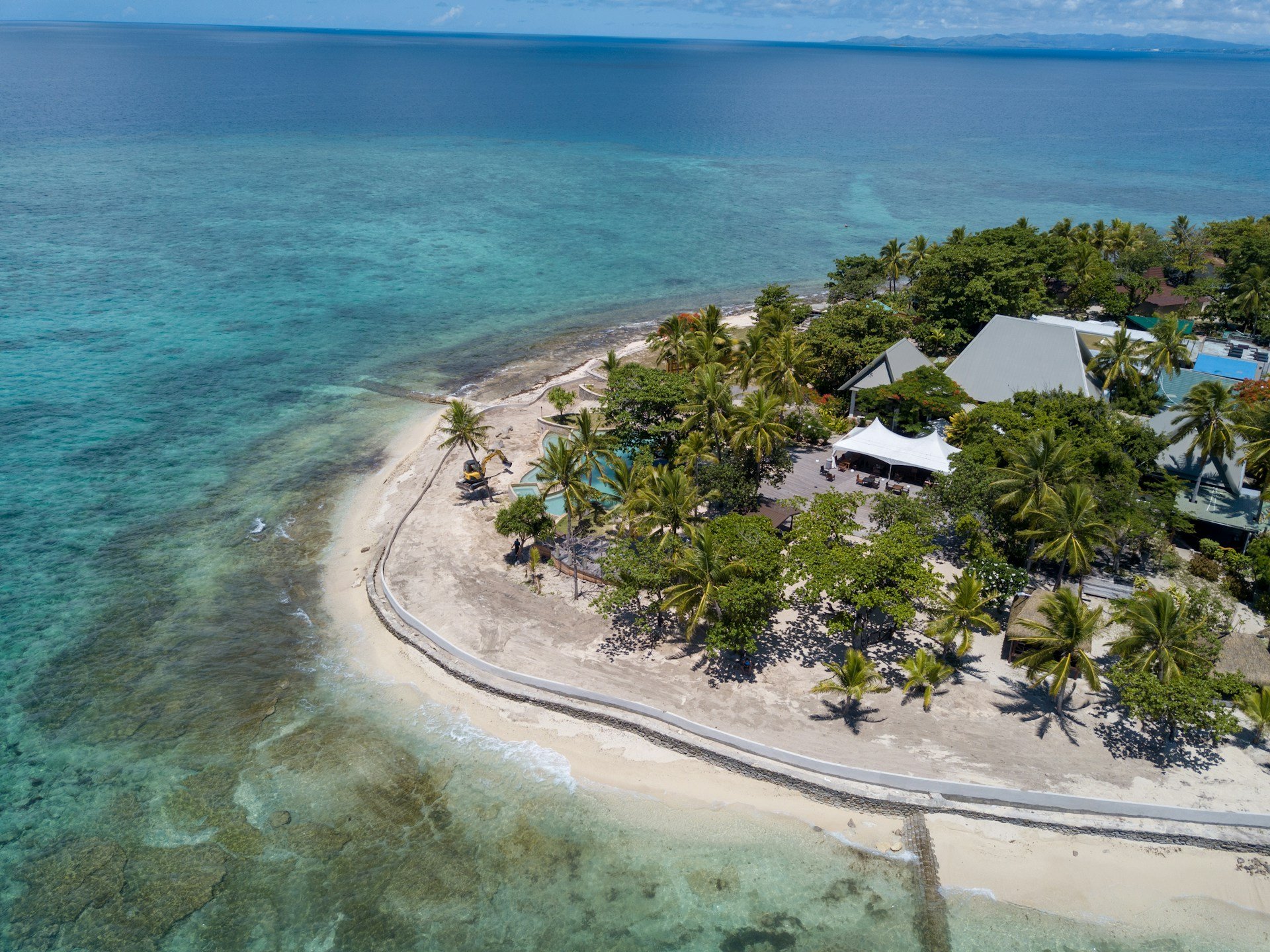
What You're Actually Getting Into
Kiribati receives fewer than ten thousand visitors a year. The country spans more ocean territory than any other Pacific island nation, 3.5 million square kilometres of exclusive economic zone, while its total land area is only 811 square kilometres, much of it barely above sea level. This is not a destination for beach holidays or reef snorkelling in the way Fiji and French Polynesia are. It's a destination for people who want to understand something about the Pacific, and about the earth's current trajectory, that no other destination teaches as directly.
South Tarawa, the capital atoll, is genuinely unlike anywhere else in the Pacific: approximately 60,000 people live on a narrow strip of land between 200 and 800 metres wide and about 30 kilometres long, a population density comparable to parts of urban Tokyo, on a coral atoll averaging two metres above sea level with no high ground, no rivers, and no sewerage system in most areas. Beyond South Tarawa, on the outer Gilbert Islands, the Phoenix Islands, and the Line Islands including Kiritimati (Christmas Island), Kiribati is something else entirely: traditional, slow, and genuinely hospitable in a way that depends on the maneaba (meeting house) culture rather than tourist infrastructure.
The honest complications
The sanitation crisis on South Tarawa is real and documented: the groundwater lens is contaminated across large areas, and the overcrowding is the direct result of internal migration from outer islands where services are even more limited. Climate change is not background information for Kiribati, it's the central fact of the country's present and future. The government has purchased 6,000 acres of land in Fiji as a precautionary measure against the possibility that South Tarawa and the lower-lying atolls become uninhabitable within this century. Visiting Kiribati is an act of witnessing rather than a luxury holiday, and this guide is written for people who understand that going in.
A History Worth Knowing
The Gilbert Islands, now the central and most populated part of Kiribati, were settled by Micronesian and Polynesian peoples approximately 3,000 years ago. The society that developed was governed through the maneaba system, the community meeting house where decisions are made by te roro, a process of discussion toward consensus that continues to be the primary political technology of I-Kiribati governance at the village level today.
- ~1000 BCE
Settlement of the Gilberts. Micronesian and Polynesian peoples settle the islands; the maneaba social system and te roro consensus process develop.
- 1892
British protectorate. Britain establishes a protectorate over the Gilbert and Ellice Islands, formalized as a colony in 1916.
- Nov 1943
Battle of Tarawa. American Marines assault Betio islet; in 76 hours, approximately 5,700 people die on a piece of land smaller than Central Park.
- 1975
Ellice Islands separate. The Polynesian Ellice Islands vote peacefully to separate from the Micronesian Gilberts, becoming Tuvalu in 1978.
- 1979
Independence as Kiribati. July 12; the new nation includes 33 atolls across 3.5 million km² of ocean.
- 2006-2010
Phoenix Islands Protected Area. Established and inscribed as a UNESCO World Heritage Site, protecting 408,000 km² of pristine ocean.
- 2014
Kiribati buys land in Fiji. President Tong announces the purchase of the Natoavatu Estate as a precautionary measure against sea level rise.
Read the full history: the Tarawa battlefield, the date line, and Anote Tong
The Pacific War came to the Gilbert Islands with Japanese occupation in December 1941. The Battle of Tarawa in November 1943, specifically the battle for Betio islet, was one of the most concentrated and lethal engagements of the Pacific campaign. American Marines assaulted a fortified position held by approximately 4,800 Japanese defenders; the reef proved too shallow for landing craft at low tide, forcing Marines to wade hundreds of metres through fire. In 76 hours, approximately 1,009 American Marines and 30 sailors were killed and 2,101 wounded; the Japanese garrison was almost entirely destroyed, fewer than 17 Japanese soldiers and 129 Korean laborers survived. In 1994, Kiribati moved the International Date Line east of its territory to ensure all its atolls shared the same calendar day, making the Line Islands the first inhabited land to greet each new day.
Former President Anote Tong, who served from 2003 to 2016, became the most internationally prominent voice on climate change from a frontline Pacific nation, combining moral authority, describing the future of his own country and people, with intellectual precision distinctive in international negotiations. He bought land in Fiji not because he believed evacuation inevitable but because, as he explained, a parent buys insurance not expecting the house to burn but because they cannot afford the risk of not being prepared. His successor, President Taneti Maamau, has emphasized adaptation and resilience, seawalls, land reclamation, freshwater management, over migration, but the basic geography remains unchanged.
Top Destinations
Kiribati's destinations are scattered across more than 4,000 kilometres of the central Pacific, reached by Air Kiribati inter-island flights, inter-island vessels on community supply schedules, and the single international connection through Fiji. The practical itinerary for most visitors concentrates on South Tarawa and either Kiritimati or one outer Gilbert island.

South Tarawa & Betio Battlefield
South Tarawa is where the government is, where Bonriki International Airport is, and where 60,000 people live on a strip of land barely wider than a runway in many places. Betio, the westernmost islet, is the primary battlefield site: Japanese coastal gun emplacements, including enormous 8-inch guns brought from Singapore, point seaward on the lagoon side, and a tank wreck is visible at low tide on the reef flat. This isn't managed heritage tourism; it's a real battlefield where the ground is still disturbed.
Kiritimati (Christmas Island)
The world's largest atoll by land area, 388 square kilometres, sitting 4,000 kilometres northeast of South Tarawa in the northern Line Islands. The bonefish flats are described by anglers who've fished globally as the finest in the world, underpressured for decades, with permit and milkfish adding variety no other destination matches. The island also hosted British and American atmospheric nuclear weapons tests from 1957 to 1962, a legacy that remains contested and incompletely addressed.
Outer Gilbert Islands
The 16 atolls beyond South Tarawa are the traditional Kiribati that the overcrowded capital has moved away from. Abemama is the most accessible and was the base for Robert Louis Stevenson, who lived there for months in 1889. Each outer island has its own maneaba, its own genealogical histories, and its own specific character; the southernmost atolls are the most traditional and the most practically challenging to reach.
Phoenix Islands Protected Area
The PIPA covers 408,250 square kilometres, the world's largest UNESCO World Heritage marine protected area. The eight uninhabited islands at its center rise from some of the deepest ocean in the Pacific; access requires a government permit granted almost exclusively to accredited scientific expeditions. Nikumaroro, in the southern group, is the island where some researchers believe Amelia Earhart died after her 1937 disappearance, unproven but not disproven by fragmentary evidence.

Culture & Etiquette
I-Kiribati culture is centered on the maneaba, the communal meeting house that is the social, political and ceremonial heart of every village. Sitting positions within it are encoded by lineage and status; visitors are allocated guest positions and are expected to sit cross-legged, avoiding pointing their feet at others, since feet are considered the lowest part of the body.
Do
- Learn the pronunciation. "Kiribas" not "Kiribati," "Kirisimas" not "Kiritimati." Every I-Kiribati person you speak to will notice.
- Accept food when offered. I-Kiribati hospitality centers on sharing food; refusing it in a village context is a significant social slight.
- Dress conservatively away from the beach. Women should cover shoulders and wear skirts or trousers below the knee in villages and towns; swimwear stays at the beach.
- Visit the Betio battlefield with respect. Not a theme park; a place where nearly 6,000 people died in three days.
- Engage with the climate reality. I-Kiribati people are acutely aware of their situation and generally welcome, rather than resent, thoughtful questions about it.
Don't
- Walk through private land without permission. Land is deeply tied to family identity and lineage; ask the village unimwane (elder) for guidance.
- Point your feet at people. Considered disrespectful, particularly in maneaba contexts; cross-legged sitting is the safe default.
- Photograph people without explicit permission. Particularly children; small communities will know about an unauthorized photo within hours.
- Treat South Tarawa's sanitation issues as spectacle. Apply the same ethical framework you would to photographing poverty anywhere.
- Underestimate the logistics. Flights cancel without notice; plan with significant flexibility, not against a rigid schedule.
Deeper culture: the maneaba, te roro, and toddy
The maneaba. Every village has one; the structure is traditionally open-sided, built to allow the trade wind through, with specific sitting areas allocated to different family lineages. It's not a museum piece; it's in active use every day, and the Ambo maneaba on South Tarawa is the national maneaba, where I-Kiribati parliament meets in traditional session alongside its formal legislative function.
Te roro, consensus governance. No vote is taken; discussion continues, sometimes for hours across multiple sessions, until the community reaches a position all members can accept. This governance technology, refined over three thousand years on atolls where community cohesion is existential, is the functional mechanism of I-Kiribati village life today.
Toddy (karewe). The sap of the coconut flower bud, collected twice daily by skilled climbers. Fresh morning toddy is sweet and low-alcohol; fermented for two to three days it becomes moderately alcoholic. It provides vitamin C in a diet where fresh vegetables are scarce, a genuine nutritional cornerstone as well as a social drink offered to visitors as a gesture of welcome.
Food & Drink
I-Kiribati food is honest and limited. The atoll environment produces a narrow range of fresh ingredients: coconut in every form, pandanus fruit, breadfruit, and taro where the freshwater lens is sufficient. Protein comes almost entirely from the sea. The outer islands have no restaurants; food there is what your host provides.
Fresh Tuna $5-15 AUD
Kiribati sits amid the world's most productive tuna fishing grounds. At the Bairiki fish market, caught the previous night, a whole yellowfin costs $5-15 AUD, grilled over coconut husk charcoal with boiled taro or rice. Nothing you'll eat in Kiribati will be fresher.
Coconut in Every Form
Young green coconuts for drinking water, $0.50-1 AUD from roadside vendors; mature coconut cream as the cooking fat and sauce base; copra as the primary export commodity. Kiribati runs on coconut in a way no other country quite matches.
Breadfruit
Boiled, baked in fire embers, or deep-fried in coconut oil. Te keibwi, breadfruit fermented for months in an earth pit, is the traditional long-term storage food; the fresh version with coconut cream and fresh tuna is one of the genuinely excellent meals available at zero cost at a traditional community meal.
Coconut Crab
Te kumimaro, the largest land invertebrate on earth, considered a delicacy on the outer islands where it hasn't been hunted to local extinction; boiled or grilled with a rich flavor from its coconut diet.
Toddy (Karewe)
The sap of the coconut flower bud, sweet and low-alcohol fresh, moderately alcoholic after two to three days of fermentation. A genuine nutritional cornerstone as well as a social drink.
Imported Beer
Australian lager (Victoria Bitter, Carlton) at South Tarawa hotels and a handful of Betio bars, with a substantial markup over Australian retail prices due to shipping costs.
When to Go & Itineraries
Kiribati has a tropical climate with year-round heat and humidity; there's no true dry season, though the trade wind period from May to October offers the most comfortable conditions. Cyclone season runs November to April, and king tides, most significant November to January, flood low-lying parts of South Tarawa and demonstrate directly what sea level rise means in practice.
All seasons compared, with temperatures
| Season | Verdict | Temps | Notes |
|---|---|---|---|
| May-Oct | Best | 28-32°C | Trade winds cool conditions; clearest lagoon diving visibility; preferred bonefishing season |
| Apr, Nov | Good, shoulder | 30-34°C | More rain likely; outer island supply schedules unaffected by season regardless |
| Nov-Mar | Think twice | 30-36°C + high humidity | Cyclone risk; king tides most significant Nov-Jan, the most direct experience of sea level rise but genuinely disruptive to the community |
South Tarawa averages, equatorial heat year-round. The northern islands (Kiritimati, Butaritari) are similar; the southern Gilberts are slightly drier.
Itineraries
A week covers South Tarawa plus one outer island if flight schedules cooperate. Kiritimati is logistically a separate trip via Fiji. Allow 7-14 days of buffer beyond any planned outer island time for flight cancellations and weather delays.
- Days 1-3
South Tarawa. Bairiki fish market at dawn, the Betio battlefield and gun emplacements, the South Tarawa road end to end, a community maneaba visit if arranged.
- Days 4-7
Outer island (Abemama or Butaritari). Fly Air Kiribati; community guesthouse meals, early morning fishing with locals, the Robert Louis Stevenson site on Abemama, a toddy-cutting demonstration if your host can arrange it.
- Days 1-4
South Tarawa deep. A guided battlefield tour with specific positions pointed out, the Te Umanibong cultural centre, the Ambo maneaba, and supply shopping for the outer island journey.
- Days 5-10
Outer Gilbert island(s). Six days across one or two islands; community homestay, outrigger canoe fishing, maneaba cultural events if timing aligns, night skies without light pollution.
- Days 11-14
Kiritimati. If schedule permits, via Fiji: four days of bonefishing with Captain Cook Hotel guides on the world's finest flats, a day circuit around the atoll's interior roads.
Getting there & around
Fiji Airways flies Suva (Nausori Airport, not Nadi) to Tarawa about four times weekly, roughly four hours; there are no direct connections from Australia, New Zealand, Europe, the US or Asia. On South Tarawa, minibuses run the atoll road continuously at a flat $0.50 AUD fare.
All transport options with prices: Air Kiribati, inter-island vessels, minibuses
| Option | Price | Notes |
|---|---|---|
| Air Kiribati (inter-island) | $80-200 AUD/sector | Small aircraft; schedules change frequently due to weather and availability. Hold return tickets loosely. |
| Inter-island vessels | $20-60 AUD/island | Supply ships on community schedules, 12 hours to several days; the authentic transport, but requires flexibility measured in days. |
| South Tarawa minibus | $0.50 AUD flat | The primary transport for residents; flag one down on the main road, dawn to around 10pm. |
| Car & motorbike hire | $50-100 AUD/day | Drive on the left; useful for the battlefield tour, no hire available on the outer islands. |
The outer island reality: the correct mental framework is that you'll leave an outer island when transport is available to take you, not on a fixed schedule. If you have a non-negotiable international flight from Tarawa, don't travel to an outer island unless you have a generous buffer. Trip.com has fixed-price pickups from Bonriki International Airport.
Where to stay
Otintai Hotel, Tarawa
The best hotel on South Tarawa, air conditioning, hot water, an on-site restaurant, and staff experienced enough with international visitors to be practically helpful with logistics.
Captain Cook Hotel, Kiritimati
The dedicated fishing base for the island's world-class bonefishing; book through specialist bonefishing tour operators rather than directly for reliable guide services.
Community guesthouse, outer islands
A room, usually with a fan where power exists, shared bucket shower, meals of local food included; operated by families experienced in hosting visitors.
Budget Planning
Kiribati isn't cheap despite being one of the world's least-developed nations; everything imported costs significantly more than its Australian or Fijian retail price. Daily expenditure can be modest, the minibus is $0.50 AUD, the fish market is $3-10 AUD per meal, but the initial investment in flights and logistics through Fiji is substantial.
- Bairiki Inn or budget guesthouse
- Fish market and local food
- Minibus transport, $0.50/journey
- Outer island community guesthouse
- Otintai Hotel with breakfast
- Guided battlefield tour
- Air Kiribati outer island travel
- Bottled water and supplies
- Captain Cook Hotel fishing package
- Professional guide per day
- Boat transport to the flats
- Meals included in package
Quick reference prices, and the real cost of getting there
| Minibus fare, any distance | $0.50 AUD |
| Fresh tuna, Bairiki market | $3-10 AUD |
| Hotel restaurant meal | $15-30 AUD |
| Bottled water, 1.5L | $2-3 AUD |
| Otintai Hotel per night | $80-150 AUD |
| Air Kiribati outer island flight | $80-200 AUD |
| Kiritimati fishing day, guided | $300-500 AUD |
Prices reflect July 2026 research and drift over time. The true cost of Kiribati is getting there: a 14-day trip including flights from Australia typically runs $3,000-5,000 AUD per person once the Fiji routing is factored in.
Visa & Entry
Citizens of the US, UK, Australia, New Zealand, Canada and most other Western nations receive a visa on arrival at Bonriki International Airport for stays up to 30 days, extendable to 3 months. You need a valid passport, a return or onward ticket, and evidence of sufficient funds; Kiribati receives few enough visitors that immigration isn't a high-pressure experience.
✓ Valid passport
At least 6 months validity beyond your intended departure date from Kiribati.
✓ Return or onward ticket
Required for visa on arrival; have your departure flight confirmation available.
✓ Sufficient funds evidence
Typically a credit card or cash; $100 AUD per day of stay is the general benchmark.
⚠ Phoenix Islands permit
A separate permit from the Ministry of Environment is required for any PIPA visit; apply months in advance, since entering without it is illegal.
| Kiribati | Tuvalu | |
|---|---|---|
| Size | 33 atolls, 811 km² land, 3.5M km² EEZ | 9 atolls, far smaller land area and population |
| Access | Via Fiji only, 4 hours to Tarawa | Via Fiji as well, similarly demanding logistics |
| Signature draw | Betio battlefield, Kiritimati bonefishing | An even more intimate, smaller-scale atoll experience |
| Climate frontline profile | Internationally prominent through Anote Tong's advocacy | Equally frontline, comparably documented |
Safety, Solo Women & Family
Kiribati is generally safe; violent crime against visitors is extremely rare. The primary safety concerns are environmental and health-related rather than social: water safety on South Tarawa, equatorial heat and sun, ocean and lagoon conditions, and the reality of medical evacuation if something goes seriously wrong in a remote location.
Water safety
Do not drink unboiled or unfiltered tap water on South Tarawa; groundwater contamination is documented and real, and typhoid cases occur. Use only bottled or hotel-filtered water.
Sun & heat
The UV index is extreme year-round on the equator. Use SPF 50+, cover up during the middle of the day, drink water continuously, and schedule strenuous activity for early morning or late afternoon.
South Tarawa urban areas
Overcrowding and poverty create somewhat elevated petty theft and alcohol-related incident risk compared to rural Kiribati; don't display valuables, and use hotel transport rather than walking unfamiliar Betio areas after dark.
Outer island safety, ocean conditions, and medical emergencies
Outer islands: among the safest places in the Pacific for visitors. Community accountability means a visitor's presence is known to every household within hours; crime is essentially absent, and the primary risks are environmental rather than human.
Ocean & lagoon: swim at Bikenibeu near the Otintai rather than Betio, which has significant boat traffic and urban contamination. The ocean side has strong currents unsafe for casual swimming; on the outer islands the lagoon is generally safe, but ocean passes have strong tidal currents.
Medical emergencies: Tungaru Central Hospital in Tarawa provides basic care but not specialist treatment. Serious cases require evacuation to Suva or Brisbane; call your travel insurance provider before anything else in a serious situation, since they coordinate the evacuation.
Emergency numbers
Embassy contacts, via Fiji
Most countries don't have embassies in Kiribati; consular assistance runs through embassies in Suva, Fiji.
- Australia (Suva)
- +679-338-2211
- New Zealand (Suva)
- +679-331-4299
- UK (Suva)
- +679-322-9100
- USA (Suva)
- +679-331-4466
- Canada (Suva)
- +679-628-5015
Medical evacuation: Fiji Airways operates the primary connection from Tarawa and can be contacted for medical priority seating to CWM Hospital in Suva (about 4 hours) or Brisbane (5-6 hours).
Family travel & pets
Kiribati isn't a straightforward family destination given the limited accommodation, water safety concerns, and logistical variability of inter-island transport. That said, I-Kiribati society is deeply child-centred, and families with teenagers interested in history, environmental issues, or fishing will find specific experiences no other Pacific destination provides.
The Betio battlefield for teenagers, climate education, and bringing pets
The Betio battlefield makes for one of the most directly instructive historical sites in the Pacific for teenagers old enough to engage with the gravity of mass death in combat; the fortifications and tank wrecks are still there to walk among. Visiting the seawall communities and experiencing a king tide event is similarly the most direct climate change education available anywhere, producing a comprehension of the stakes no classroom lecture replicates.
Pets: not practically possible for short visits. Biosecurity requirements include a microchip, current rabies vaccination, an import permit, and a health certificate, with all animals subject to quarantine on arrival; the logistics of inter-island travel with animals in small aircraft and supply vessels are prohibitive. Leave pets at home.
Kiribati FAQ
How do you pronounce Kiribati?
Kiribas. In Gilbertese, the letters "ti" are always pronounced "s", so Kiribati is Kiribas and Kiritimati (Christmas Island) is Kirisimas. Learning this before arrival is a small courtesy I-Kiribati people notice and appreciate.
Is Kiribati safe to visit?
Yes, generally very safe. Violent crime against visitors is extremely rare, and the outer islands are among the safest places in the Pacific. The primary safety concerns are environmental: contaminated groundwater on South Tarawa, equatorial sun, and the reality that serious medical emergencies require evacuation to Fiji or Australia.
How do you get to Kiribati?
Fiji Airways flies from Suva (Nausori Airport, not Nadi) to Tarawa about four times weekly, roughly a four-hour flight. There are no direct connections from Australia, New Zealand, Europe, the US, or Asia; every route to Kiribati goes through Fiji.
Do I need a visa for Kiribati?
Most Western passport holders receive a visa on arrival at Bonriki International Airport for up to 30 days, extendable to 3 months, requiring a valid passport, a return or onward ticket, and evidence of sufficient funds.
What happened at the Battle of Tarawa?
In November 1943, American Marines assaulted the fortified Japanese position on Betio islet; in 76 hours, approximately 5,700 people died on a piece of land smaller than New York's Central Park. Japanese gun emplacements, tank wrecks, and bunkers remain on Betio today.
Is Kiribati sinking?
South Tarawa averages about two metres above sea level with no high ground, and the government has purchased land in Fiji as a precautionary measure against the possibility that low-lying atolls become uninhabitable this century. The situation is real and ongoing rather than settled, and visiting the seawall communities is one of the most direct ways to understand what sea level rise means in practice.
What is Kiritimati known for?
Christmas Island's flats are considered the finest bonefishing destination in the world, underpressured for decades and holding bonefish, permit and milkfish in exceptional density. It also hosted British and American nuclear weapons tests from 1957 to 1962.
How many days do you need in Kiribati?
A week covers South Tarawa plus one outer island if flight schedules cooperate. Kiritimati is logistically a separate trip via Fiji, and experienced travelers build in 7 to 14 days of buffer time for outer island transport delays.
Can you visit the Phoenix Islands?
Not easily. The Phoenix Islands Protected Area, the world's largest UNESCO marine World Heritage site, requires a government permit granted almost exclusively to accredited scientific research expeditions, applied for months in advance.
What language is spoken in Kiribati?
Gilbertese (te taetae ni Kiribati) is the national language and English is co-official, taught in schools from grade 3, so English navigation is straightforward for visitors, particularly on South Tarawa.
Te Rongo
There's a word in Gilbertese, te rongo, that means both news and something older than news: the specific quality of information that carries weight because it comes from a person who was present when something happened. The I-Kiribati people have been carrying te rongo about climate change for thirty years, present while the king tides came higher, present while the freshwater lens grew more saline, present while the government bought land in Fiji, not because they've given up, but because preparation is not surrender.
You can go to Kiribati and carry some of that te rongo back with you. Not the full weight of it, you'll leave and the people will stay, but enough to speak with the authority of the person who has been present in a place where the stakes of the world's largest collective action failure are measured in metres of elevation above sea level, and metres of ocean rising toward it. Go. Be present. Remember what you saw. Carry it home.